Elements of Strategy
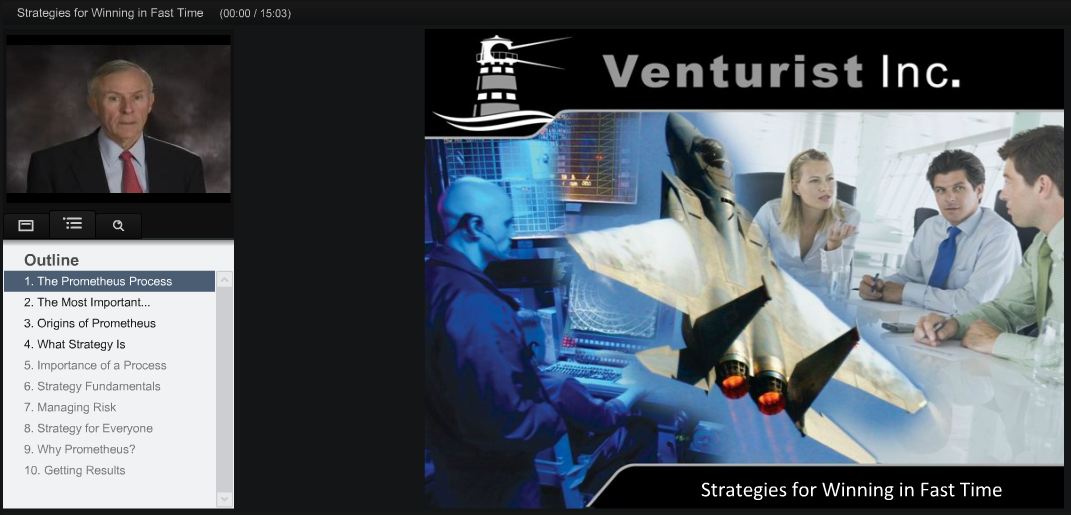
Click Below To Watch The Prometheus Process Video In-depth
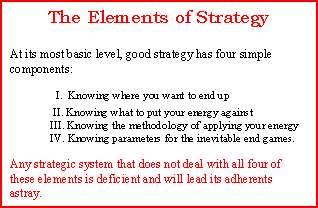
The Four Imperatives of Prometheus

Strategy is all about guiding the outcome of individual effort and events to produce sustained success. In strategic terms, success is producing a sustainable outcome that is valuable and satisfying over time. Strategy, then, is not winning battles; rather it is winning wars and more particularly the peace that follows them. Focusing on battles at the expense of wars and the subsequent peace is dangerous in the extreme and almost never leads to long-term success.
Many
people think that strategic thought and execution are very
difficult. To the contrary, almost everyone can learn to do both.
The operative word, however, is “learn.” We all grow up in a
tactical world where looking both ways before we cross the street is
a necessity for survival. Likewise, in our education we spend the
overwhelming majority of our time learning details while we spend
little time trying to integrate what we have learned—especially the
things we have learned in various disciplines. So, unfortunately,
strategy is foreign to most of us—we have had little exposure to it
and we are normally rewarded for tactical, not strategic, prowess.
If, however, we really want our efforts to produce sustained
success, then we must learn strategy at both an organization and a
personal level. Fortunately, despite the mysteries surrounding
strategy, learning to think and act strategically is not too
difficult, but it does require you to view the world in a different
way.
I: Design the Future
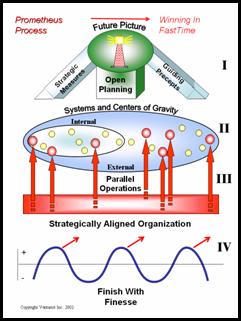
The first (and importantly first) step in strategic thinking is to identify the future that you want to create. In the Prometheus Process, the desired future is called the Future Picture. It is a very hard, very objective, very measurable picture of the future you want to create. In the Prometheus Process, you break the Future Picture into 12 separate elements that ensure a balanced future embraced by all.
Accompanying the Future Picture are strategic Measures of Merit--those measures that tell you when you have achieved your Future Picture or when you are on the right course for it. They are normally not the same measures you use at a tactical level. In fact, tactical measures can be quite dangerous when applied at a strategic level, as can the wrong measures of merit.
The third key part of designing the Future is deciding on the Guiding Precepts which will apply to the organization. Guiding Precepts describe the essence of the organization (Nordstrom’s extreme customer focus) and the boundaries you intend to accept regardless of the circumstances (the opposite of the Enron Executive Committee waiving its conflict of interest rules for off-book deals).
The Prometheus
Process assumes that the people in an organization generally know
more about their business than anyone else in the world. It also
assumes that people in an organization will make and execute smart
plans if they have a disciplined process which takes place in an
Open Planning environment. The more people who are involved in the
planning process, the faster it goes, and the more likely that the
plan will be well executed. In general, it is good to have at least
three echelons involved in the open planning process. Having three
echelons ensures that there will be good knowledge and experience in
the room. It also means that as the planning merges.
 II:
Target for Success
II:
Target for Success
There are a very large number of things against which an organization can put its resources. You know intuitively that some of those things will have much higher impact than others. The organization which targets the right things, the centers of gravity, will be far more effective at a much lower cost than the organization that has no disciplined way to choose and affect its targets.
The Prometheus
Process recognizes that everything takes place in the context of a
system and that systems have such annoying characteristics as
inertia and resistance to change. But they also have centers of
gravity—the handful of things in a system that produce
disproportionate impact when affected.
The Five Rings model—exclusive to the Prometheus Process--provides a
real-world way to understand organizations and markets as a system
and to find their centers of gravity. The best way to change a
system (your organization, your market) is by affecting its centers
of gravity.
If you want to put your organization or market on a new track, it is necessary to create rapid and hard-to-reverse system change.
To create hard-to-reverse change, you must affect system centers of gravity in a compressed period of time. Doing so significantly reduces the ability of the system to resist what you want it to do and the change tends to stick.
III: Campaign to Win
With the Future Picture standing before everyone as a clear beacon to guide actions, you begin to attack the centers of gravity previously identified. You do this with campaign teams drawn from across the organization and consisting to the maximum extent possible of those who participated in the creation of the Future Picture and the identification of the centers of gravity.
It is the objective of the campaign teams, continuing to work in an open planning environment, to affect the centers of gravity in parallel, which means to affect them in a very compressed time frame. Compressed, parallel operations have far higher probabilities of success than do stretched-out serial operations and paradoxically cost much less.
It is almost always the case that the current organization structure will not be optimum for a new strategy, especially if it involves an aggressive Future Picture. That being the case, part of Campaigning to Win is to modify the structure as required to allow the organization to move fast and accurately against the centers of gravity. The campaign teams themselves, of course, are designed for rapid action and will normally provide the bridge to a new formal structure. In the interim, however, the organization is acting and winning in the real world and is not waiting for the development of a new structure.
IV: Finish with Finesse
In the real world, every business cycle and product has a beginning and an end. Even though we know this to be the case, very few organizations plan for the back side of the inevitable cycle. The failure to plan in advance means that too much energy is devoted to the wrong things. In the Prometheus Process, you plan so as to exit cycles and products with maximum gains.
The Cardinal Rules are a set of
guidelines that are invaluable to follow while planning and
executing whether at a strategic or tactical level.
If you follow these rules, you are more likely to be
successful than if you ignore them.
What follows is a very brief review of each rule with an
associated additional illustration of the idea.
·
 Think
Like an Architect—Not Like a Bricklayer:
Start with the overall
big-picture concept, and then work to the details.
If you start with the bricks, you will build a brick
structure whether or not that is the right choice.
Non-architectural thinking almost always ends up with a
serial operation (see Parallel Operations)which means a very
contorted path forward in time.
Motorola’s introduction of the Iridium satellite phone
network failed to follow this rule.
Think
Like an Architect—Not Like a Bricklayer:
Start with the overall
big-picture concept, and then work to the details.
If you start with the bricks, you will build a brick
structure whether or not that is the right choice.
Non-architectural thinking almost always ends up with a
serial operation (see Parallel Operations)which means a very
contorted path forward in time.
Motorola’s introduction of the Iridium satellite phone
network failed to follow this rule.
·
Focus on the Future:
Value is in the future, not in
the past. If you
don’t focus on the future, you will end up repeating what you
did yesterday, albeit with some modification—which tends to be
marginal. The
Pennsylvania Railroad violated this rule and went bankrupt in
the process.
·
Execute Good-Enough Plans:
The world is changing while you
are planning. If
you take too long to plan in an attempt to create a perfect
plan, the world will have changed sufficiently to invalidate
your initial assumptions, or more likely, someone with an action
bias will have stolen a march.
Michael Dell followed this rule as he introduced new
computer buying methods quickly and then improved them over
time.
·
Go to Rome:
All of us have a tendency to
concentrate on the immediate problem without keeping in mind
what you really want to accomplish.
Rome may be a place, but more often it is a state of
being. Bill Gates
did an excellent job in this area where almost from the
beginning, his Rome state of being was a company that had the
dominant graphical user interface software and associated
applications that were of interest to the majority of computer
users.
·
Concentrate for Success:
Although this seems obvious, we
frequently deploy our resources to avoid tactical failure rather
than to maximize strategic success.
Properly thought through, however, we can deploy our
resources in such a way as to improve our chances of success
while giving us a mechanism to deal with genuinely strategic
threats—which probably means ignoring some of the tactical
problems. Early
Japanese automobile makers did a great job here as they focused
themselves on markets in which they could succeed—first at home
and then in the US.
·
Defend All—Lose All:
This Cardinal Rule is the evil
twin of Concentrate for Success.
It says that nobody is powerful or rich enough to defend
all their markets and products and that some are worth more than
others. If you try
to defend them all, you end up losing them all.
The famous department stores of yesterday violated this
rule by trying to be all things to all customers—something they
simply were not able to do in the face of specialty stores and
the big box discounters.
·
Stay Out of the Balkans:
Don’t sink scarce resources
into projects that will not have much, if any, impact on
strategic success even if they are successful.
Balkans are projects that may look great on the surface
and may be quite well run but which consume resources and
management time that should be spent on strategic issues.
British Petroleum in 2006 seemed to become so mesmerized
with its environmental crusades that it forgot to pay attention
to strategic interests such as its Alaskan pipelines.
·
Maximize Friends, Minimize Enemies, Choose Wars:
You can never have too many
friends whereas even a single enemy creates a potential problem.
Even if you are very strong, many enemies will eventually
destroy you just as the tiny Lilliputians were able to enslave
Gulliver. Wars
(think competitors) are very expensive and chancy.
The ideal world is one where you have no competitors and
your major chore is to find new customers and sell to them.
This is sometimes thought of as finding blue water
opportunities (see Blue Ocean Strategy).
Cirque de Soleil created a market between the circus and
the Broadway show where it basically had no competitors.
·
Don’t Underestimate What It Takes To Win:
Few endeavors turn out to be as
inexpensive in money and energy as original prognostications
predict.
Unfortunately, great enterprises in war and business start out
grossly underestimated.
The frequent result is failure with concomitant loss of
the entire investment.
Careful, conservative estimates of cost may keep you out
of some good projects, but you are far more likely to succeed
with the ones you do undertake.
In addition, conservative funding of a project probably
means that you will automatically have something in
reserve—which will mean that you are following another Cardinal
Rule—Maintain and Use Reserves.
When developing
a business plan for a new company, product, or project, planners
typically make cost estimates in order to assess whether
revenues/benefits will cover costs (see cost-benefit analysis).
This is done in both business and government. Costs are often
underestimated resulting in cost overrun during implementation.
Main causes of cost underestimation and overrun are optimism
bias and strategic misrepresentation (Flyvbjerg et al.
2002).[1]
In the home improvement area, the author
has adopted the “rule of 9” for
estimating time.
Decide how long a project will take, multiply by three, then
multiply by three again.
This is generally accurate and helps avoid taking on
projects where the time to dothem is simply not available.
·
Don’t Deceive Yourself:
The terms “articulated” and “axiomatic” describe the
common phenomenon where the leader of an organization announces
a bold new plan (articulated), then promptly continues doing
everything the old way (axiomatic).
People and organizations frequently (mostly?) confound
themselves by failing to force change in axiomatic behavior to
match the new articulated policy.
The default is for people to revert rapidly to their old
way of doing something (axiomatic) and that is exactly what will
happen absent strenuous and open efforts to prevent it.
This rule applies not only to new policies but also to
maintaining old ones.
For example, Nordstrom’s has long had an axiomatic policy
of customer service, but knows that it needs to articulate it
constantly, to back it up with the right hiring, training, and
incentive programs lest even its legendary service collapse.
If you say you are going to do something, mean what you
say, then demonstrate it by your own actions to include building
the support programs necessary to align organizational behavior.
·
Maintain Momentum—Bypass Barriers:
Time is the most precious strategic asset.
When an organization gets hung up on a barrier, it loses
time which can never be replaced.
To avoid losing time, make it part of the organization
psyche always to look for ways to maintain forward velocity.
·
Be Offensive—When In Doubt Attack:
The “When in Doubt” part of this rule flows from a 19th
century Prussian military observation that if a commander was in
doubt whether to attack or defend, the situation was probably
close to equilibrium which meant that whoever moved first could
probably tip it in his direction.
The reason behind this is clear:
if the other side is retreating or attacking, then you
have no doubt about what you must do.
If nothing is happening, it almost certainly means that
both commanders are in doubt.
When a situation is roughly balanced, a little effort can
go a long way just as it doesn’t take much to move one end of a
centered seesaw. In
other words, the injunction to attack when in doubt is not gun
slinging. In the
commercial world, you have a good chance of success in going
into a new market if you are in doubt about whether to do it or
not. The fact that
you are in doubt probably means that the situation looks
reasonably attractive and either that someone else doesn’t
already own the market or someone who is in the market is not
doing much with it.
·
Maintain and Use Reserves:
It is not possible to forecast the
details of the future with much precision.
You do know with near certainty, however, that something
either good or bad will arise with which you need to deal.
Reserves are the things that give you the ability to deal
with threats and opportunities without destroying everything
else that you are doing.
Reserves can be people, money, equipment, facilities, or
even a little time left open on your daily schedule.
If you try to operate everything at 100% of capacity,
something will break with frequently catastrophic results.
Unfortunately, human nature drives us away from reserves
because we think that something not fully committed is being
wasted or we believe that it is better to bet everything up
front rather than to hold something back.
Both ideas are demonstrably false which becomes clear
when we think about probabilities—which are always less than
“1.” Financial
planners typically advise people to have an emergency fund that
covers six months of expenses in the event that they lose their
job. This is a good
example of maintaining reserves where having the reserve means
that you don’t lose your house when you lose your job.
·
Impose Your Plan:
As Captain Jean-Luc Picard says in Star Trek: The Next
Generation, “make it so!”
If you are going to the trouble of planning, you really
ought to do everything to ensure that your plan works as
written. If you
have done a good planning job, there is no reason why you should
not get quite close.
If, on the other hand, you fall back on the really stupid
bromide “no plan survives first contact with the enemy,” you
give yourself every possible excuse to do lousy planning—which
will not survive
first contact with the enemy!
If you don’t make every effort to impose your plan on the
competition whether it be a market or a state, the competition
will thank you profusely and do what it thinks is best, which is
highly unlikely to be good for you.
In the ideal world, your plan is so good and so well
executed that no one has the ability to react.
Get as close to that ideal as possible and recognize
danger whenever the competition has the opportunity to react to
your actions. At a
detail level, even if you can’t dominate the entire spectrum,
try to do things that are difficult to counter.
When Braniff tried to counter upstart Southwest Airline’s
low fare flights between Houston and Dallas with its own fare
reductions, Southwest began offering its passengers a free
bottle of Scotch.
It worked because Braniff, as a big established airline, was
unlikely to be able or want to deal on this level.
Southwest imposed its plan.
·
Make Time Your Servant:
The Time Value of Action (see Parallel Operations) is a
strategic observation of the highest importance.
If you take a long time to do something and you do it one
step at a time, your costs will be high and your probability of
success much lower than if you do it fast.
You must understand and control time.
If you don’t, time and your opposition will control you.
Airbus, as of early 2008, is paying a huge price for being so
slow and serial in the introduction of its new aircraft.
Costs have skyrocketed while customers have cancelled
orders in favor of Boeing.
Failure to make time its servant has cost Airbus far more
than it would have cost to have bought the capability to the job
correctly in a minimum amount of time.
[1]
Cost. (2007, March 10). In Wikipedia, The Free
Encyclopedia. Retrieved 13:24, March 21, 2007, from
http://en.wikipedia.org/w/index.php?title=Cost&oldid=114171474